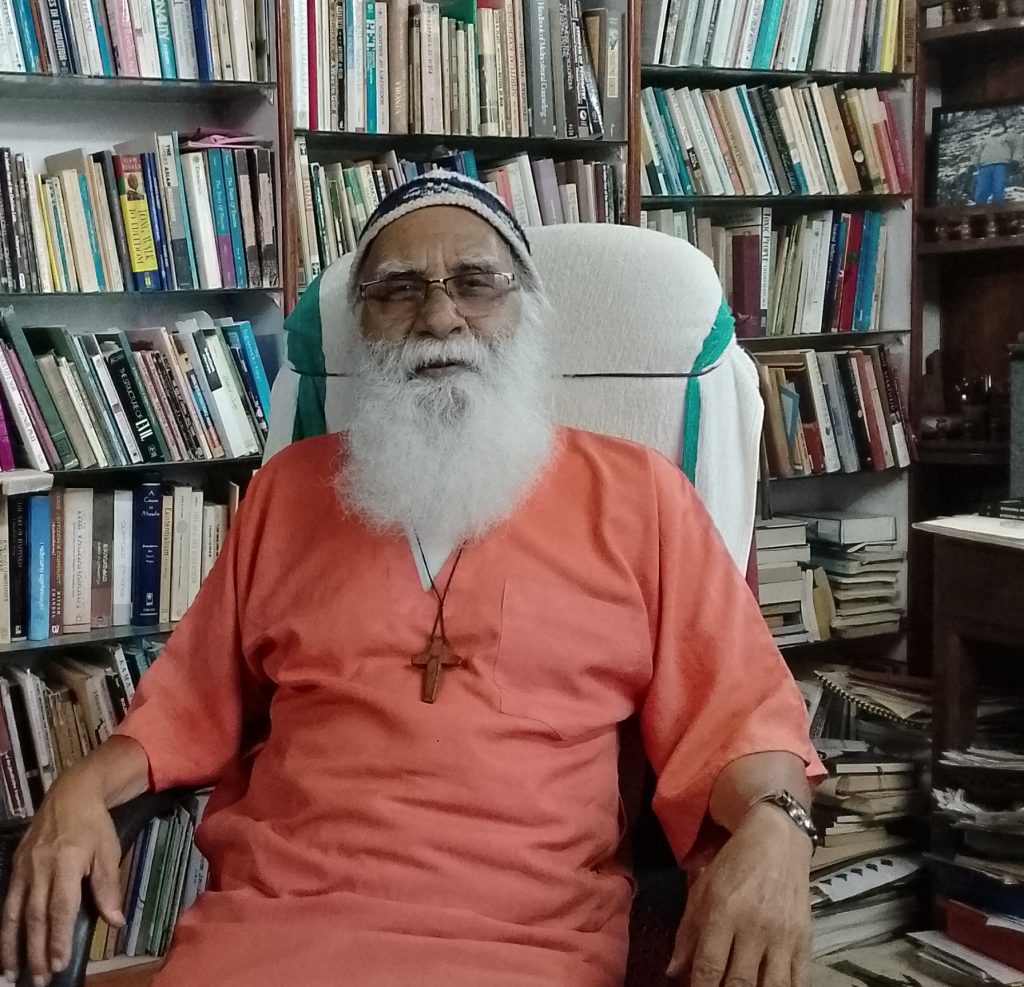
Dr. John Thekkedam, alias Swami Snehananda Jyoti, is the Founder Director of East West Awakening and Viswa Shanti Foundation. He was born in Kerala in 1940 and was a Jesuit for 25 years. He left the Jesuits to start his own institutions called East West Awakening and Viswa Shanti Foundation. He is mostly based in Munnar where he has an ashram called East West Awakening Centre. He has three other institutions as ashram-cum resorts in Kanyakumari (Tamil Nadu), Palaruvi near Palaruvi Waterfalls in Aryankvu, and at Kudamalur in Kottayam district.
Erudite and well educated, Dr. Thekkedam has several degrees to his credit: Ph.D. in Psychology from St. Louis University, U.S.A., Masters in Psychology from Delhi University, LPH (MA) in Philosophy, BPh & BTh from Gnana Deepa Vidyapeeth in Pune, Maharashtra, and B.Ed. from Sardar Vallabhbhai Patel University, Gujarat. He has authored about a dozen books dealing with spiritual and psycho-spiritual topics.
Interviewer- Fr. P. A. Chacko S.J.
Q. Swamiji, what inspired you to get into Ashram life?
A. I enjoyed my life for 25 years in Jesuit communities and got a taste for community living. When I left the Jesuits, my experience inspired me to form a commune in America where I was practicing as a Psycho-therapist. Somehow the commune system with 20 persons did no work out on expected lines.
Then I returned to India in 2006 and started a community living program to propagate the values of universal fellowship and harmony. Those who come to my ashram for short periods imbibe values of holistic living, spiritual values in terms of human fellowship, peace, inner freedom, respect for all religions and the like.
Q. What is meant by East-West spirituality? What message you convey through your institutions?
A. The East-West Spirituality is a universal spirituality common to all human beings. It accepts all that is good, and leads to a Spirit-filled life. The best elements of East and West are integrated in our ideology and way of life.
Our ideals are: Accept all people as they are. No discrimination; holding belief in one Universal God, one Spirit (universal); compassion; freedom; peace; love; tolerance, and respecting the right of people to hold or express their opinion even if we may not agree to them. My spirituality is beyond Religions taking everything from everywhere.
Q. In today’s world situation of wars, religious fundamentalism and terrorism, what practical steps do you propose?
A. We preach peace among warring nations. We propose dialogue and negotiations to settle disputes. International bodies like the United Nations need to exercise their power to intervene effectively. Religious leaders should control their members from indulging in fundamentalist propaganda and unholy acts that disrupt human harmony.
Terrorism is a symptom due to injustice or cruelty. Hence, such issues need to be tackled sensibly at the root level to forestall terrorism.
Q. How do you understand the role of religion in effecting human fellowship and harmony?
A. Religion is a way to God. We should use positive values of religions and religious scriptures for building peace and harmony. All that promote hatred and enmity should be avoided. Inter-religious dialogues and common programs can be practiced.
Q. How would you understand the environmental and ecological issues the world is facing?
A. We are all citizens of this beautiful world. We have a responsibility to keep it beautiful and unpolluted. Global issues affecting environment and ecology should be tackled by world leaders and nations. Wars and nuclear explosions can destroy land and cause pollution and harm to living beings. Wars should be condemned. The U.N. should propose effective actions to stop all that harm environment.
Q. What future you envisage for the institutions you have set up?
A. I have no specific plan. I trust in God. I have instituted a Trust. I believe it will carry on whatever is needed.
Q. How would you like to be remembered by future generations?
A. I like to be remembered as a person who loved all, accepted all, and harmed nobody.